Happy Parents = Successful Kids
Are We Having Fun YetHappy Parents = Successful Kids is the central proposition that Kay Willis uses to redefine parental success: children flourish not simply because parents secure excellent opportunities for them, but because parents remain emotionally available, contented, and capable of enjoying family life. The expression turns happiness from a private luxury into a condition of responsible parenting, while making the quality of family relationships a more decisive measure than external achievement.
Definition and Standard of Success
Willis explicitly contrasts her standard with the familiar emphasis on standardized tests and SAT scores. Academic accomplishment may matter, but it is not the final proof of successful parenting. For her, success means raising a contented human being who contributes to society and still enjoys being in the same room with a parent. This definition joins individual well-being, civic usefulness, and durable affection: a child is successful not merely when the child performs well, but when the child becomes a humane person whose presence can still be shared with the family.
The expression also places the parent inside the measure. Willis’s formulation does not treat children as isolated products of instruction, discipline, or opportunity. It asks whether the family can remain together without hostility and whether children continue to value one another’s company as well as their parent’s. The standard therefore shifts attention from visible credentials to the emotional life that credentials cannot capture.
Family Evidence and the Meaning of Happiness
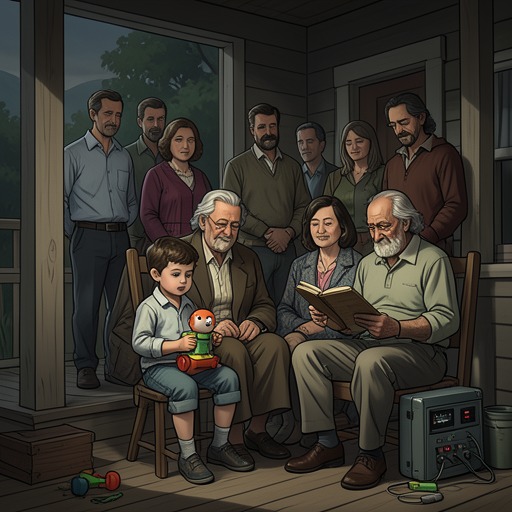
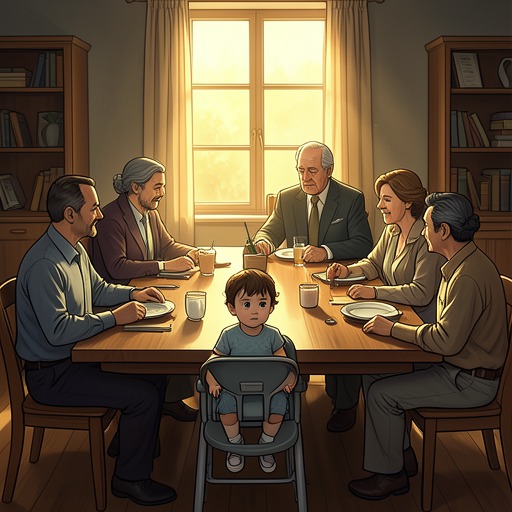
Willis presents her own large family as evidence for the claim. All ten of her children attended college, and some earned graduate degrees, so the expression does not reject education or ambition. Yet she identifies one of her greatest successes elsewhere: the children can still occupy the same room as a family without a fight breaking out. Their ability to enjoy one another, as well as her, becomes more telling than their academic records because it demonstrates a relationship that has endured beyond the dependent years of childhood.
This example gives the phrase its causal force. Parents may provide lessons, special opportunities, and an excellent education, but these are supplements rather than substitutes for the parent’s presence. Willis describes the parent as the most important gift a child receives, a claim that makes emotional availability more fundamental than accumulation. Failure in childrearing consequently harms both generations, while success produces a reward that is extraordinarily rewarding and life-lasting: children who remain connected to one another and to the parent who raised them.
Emotional Work Behind the Principle
The principle depends on work that is often invisible. Willis argues that mothers are usually the principal creators of the physical and emotional atmosphere in which children grow, whether those mothers work outside the home full-time, part-time, or not at all. Fathers contribute, but the emotional climate is more often shaped through the mother’s daily responses, tone, patience, and management of domestic life. Atmosphere and attitude are therefore the two central elements of what she calls the AAs of parenting.
That emotional labor includes listening. Willis warns against crowded brain syndrome, the condition in which chores, schedules, and unfinished obligations leave no mental room for a child’s words. Good listening requires the parent’s mind and body to be present, other thoughts temporarily set aside, and the child’s feelings acknowledged. In this framework, happiness is not a cheerful performance imposed on children; it is produced through repeated acts of attention that tell them their experience matters.
The opposite condition is resentment. Willis describes resentment in the tone used when an exhausted parent answers a toddler who has been calling for Mommy for ten minutes. A sharp response can reveal that the parent’s labor has become emotionally poisoned, even when the labor itself is diligent. She argues that resentment permeates the atmosphere meant to nurture the family, blinds an overtired parent to good things, and can damage romantic love as well as parent-child relations. A parent who is deprived of fun may continue completing obligations while quietly undermining the very security those obligations are supposed to provide.
A Life-Course Argument for Parental Renewal
Willis’s own life gives the expression a long temporal reach. She grew up in Passaic, New Jersey, in a family that respected education; her father was both a doctor and a lawyer, while her mother, who never finished high school, was wise and funny. Her parents made her feel loved and intellectually capable, and she wanted to become a mother for as long as she could remember. That aspiration led into an intense early period of family life: six daughters were born in seven years, beginning with JoEllen Willis in April 1951 and ending with Jeane Willis in February 1958, with Kim Willis, Patty Willis, Maureen Willis, and Fran Willis arriving between them.
After more than twenty years as a full-time mother, Willis entered another stage when her youngest, Danny Willis, started school and two older children were already in college. Because the family income needed supplementing, she accepted part-time work overseeing luncheons for eight to fifteen people at the United Nations Plaza in New York City. The work initially involved supervising dining-room preparations, but her homemade pound cake was so well received that she began making desserts daily and then preparing the entire lunch, increasing the household income through cooking.
The later transition was educational as well as economic. When Danny Willis was about nine, Willis accepted sponsored tuition at Fairleigh Dickinson University and enrolled in the graduate-level course Women in Transition, despite having left college during her sophomore year and initially lacking the qualification. The opportunity was connected to her work with Mothers Matter and was intended to make her a role model for participating mothers and staff. Her children teased her for trying to look like a student, but the episode shows the expression operating across the life course: a happy parent is not a parent frozen into one role, but a person permitted to continue developing.
Public Lesson and Narrative Significance
The expression functions as both a slogan and a corrective to parental guilt. In the book, Willis’s message is presented as guilt-free and centered on mothers’ needs. Having fun is treated as an important parenting skill, because an overcommitted and exhausted parent is not much fun to be around. The claim does not excuse neglect; it argues that exhaustion should not be mistaken for virtue and that parental renewal protects the family rather than competing with it.
Its authority comes from the movement between lived example, practical instruction, and public testimony. The idea appears in Mothers Matter, a program that reaches mothers, fathers, new mothers, single parents, earning-money mothers, parents of adolescents, and grandparents. Willis’s work also reached a national audience through appearances on Oprah, Good Morning America, The Today Show, The CBS Morning Show, The Home Show, CNN, and The Joan Rivers Show, as well as coverage in major newspapers and consumer magazines, including Good Housekeeping. The phrase thus converts a private family philosophy into a portable public message.
At the same time, the principle exposes the burden placed on parents—especially mothers—to regulate the emotional climate of everyone around them. Its promise is humane: children need parents who are present, attentive, and capable of pleasure, not merely parents who supply achievements. Its demand is substantial: mothers are asked to manage fatigue, resentment, listening, romance, and atmosphere while continuing to meet family obligations. Happy Parents = Successful Kids is therefore both reassurance and discipline. It insists that parental happiness has consequences, and that the most lasting evidence of success may be a family whose members still choose to share the same room.